이 기사는 7년 이상 되었습니다.
유인원에서 현생 인류로 이어지는 길은 직선적이지 않습니다. Hannah Devlin은 우리가 알고 있는 것과 우리 종의 다음 단계를 살펴봅니다.

Hannah Devlin 과학 특파원2018년 2월 12일 월요일 오후 4시 51분 AEDT공유하다
원점으로 돌아가 봅시다. 우리와 유인원은 언제 갈라섰을까요?
과학자들은 아직도 정확한 날짜, 심지어 백만 년 이내의 날짜를 찾고 있습니다. 인류 진화의 많은 중요한 질문들처럼, 그 답은 지난 수십 년 동안 새로운 발견, 기법, 그리고 새로운 통찰을 제공하는 기술들을 통해 진화해 왔습니다.
유전학은 우리와 가장 가까운 현생 친척인 침팬지와의 분열 시기를 측정하는 가장 강력한 도구 중 하나로 입증되었습니다. 2005년 우리의 전체 유전체를 비교했을 때 , 두 종은 DNA의 98%를 공유하는 것으로 밝혀졌습니다. 이러한 차이는 우리 혈통이 얼마나 오랫동안 갈라져 왔는지에 대한 중요한 단서를 제공합니다. 과학자들은 세대를 거쳐 새로운 유전자 돌연변이가 발생하는 속도를 추정함으로써, 이러한 유전적 차이를 “분자 시계” 로 활용하여 언제 분열이 발생했는지 대략적으로 파악할 수 있습니다. 대부분의 계산에 따르면, 그 시기는 400만 년에서 800만 년 전 사이로 추정됩니다.
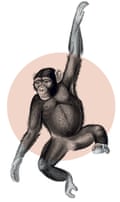
이 시간대는 원래 생각했던 것보다 더 최근입니다. 1960년대에 화석 증거를 바탕으로 고생물학자들은 1,400만 년 된 유인원인 라마피테쿠스가 턱 모양을 근거로 인류 최초의 조상이라고 결론지었습니다. 이후 DNA 분석 결과, 이 분화는 그보다 훨씬 후에 일어났으며, 라마피테쿠스는 현재 오랑우탄의 조상으로 여겨집니다.
그렇다면 과학자들은 아직도 우리와 다른 유인원 종 사이의 “잃어버린 고리”를 찾고 있는 걸까요?
우리는 아직 침팬지와 가장 가까운 공통 조상이 누구인지 알지 못합니다. 하지만 과학자들은 “잃어버린 고리”라는 표현을 싫어하는 경향이 있습니다. 진화가 명확한 연결점을 가진 질서 있고 선형적인 방식으로 진행된다는 것을 암시하기 때문입니다.
자연사 박물관의 인류 기원 책임자인 크리스 스트링거는 “이것은 마치 살아있는 원숭이와 살아있는 인간 사이의 간극을 마법처럼 메워주는 단일한 과도기적 형태가 존재한다는 느낌을 주며, 우리가 모든 것을 진화의 흐름에 맞춰야 한다는 것을 시사합니다.”라고 말합니다.
현실은 더 복잡합니다. 각 가지가 서로 다른 속도로 진화하고, 새로운 형질이 여러 번 독립적으로 나타날 수 있으며, 수천 년에 걸쳐 대륙을 가로질러 분열이 길어지면서 개체군이 갈라졌다가 다시 교배될 수 있습니다. 생명의 나무라기보다는 빽빽하고 가시투성이인 덤불에 가깝습니다.
하지만 다른 현생 유인원들과 우리 사이의 마지막 공통 조상이 침팬지와 비슷했을 것이라고 가정할 수 있을까요?
꼭 그렇지만은 않습니다. 침팬지는 단순히 우리보다 진화하지 않은 형태가 아닙니다. 우리의 가상 공통 조상은 침팬지와 유사한 특징, 인간과 유사한 특징, 그리고 두 종 모두 결국 남긴 원시적인 특징들이 혼합되어 있었을 것입니다. 그 공통 조상은 네 발로 걸었거나, 더 직립보행을 했을지도 모릅니다.
과학자들은 화석 기록에 등장하는 다양한 생물들을 바탕으로 이 진화적 퍼즐 조각을 맞추려고 여전히 노력하고 있습니다. 설상가상으로, 발견된 화석 대부분은 직계 조상이라기보다는 진화적 분지일 가능성이 높습니다.빠른 가이드
진화적 타임라인
보여주다
제가 알아야 할 중요한 화석에는 어떤 것들이 있을까요?
사람들이 우리 계통, 혹은 그 근처에 있다고 믿는 가장 오래된 표본 중 하나는 차드에서 발견된 600만~700만 년 전의 화석인 사헬란트로푸스 차덴시스(Sahelanthropus tchadensis) 입니다. 이 화석은 유인원처럼 경사진 얼굴, 튀어나온 이마, 그리고 매우 작은 뇌를 가지고 있지만, 인간과 비슷한 작은 송곳니를 가지고 있습니다. 척수는 뒤쪽이 아닌 두개골 아래에 위치하는데, 이는 이 생물이 두 발로 걸었음을 시사한다고 주장하는 사람들도 있지만, 두개골과 몇 개의 뼈만 남아 있어 확실하게 알기는 어렵습니다.
케냐에서 발견된 비슷한 시기의 또 다른 화석인 오로린 투게넨 시스 (밀레니엄 맨이라는 별명이 붙은)도 작은 이빨과 원시적인 두 발로 걷는 모습을 보여주는 다리뼈를 가지고 있습니다.
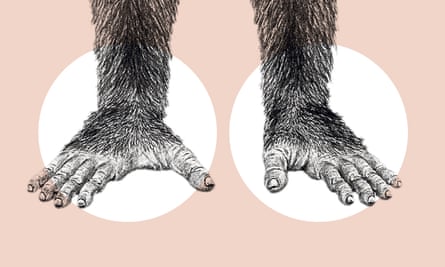
그보다 조금 뒤인 440만 년 전, 에티오피아에서 놀랍도록 완전한 여성 유골인 아르디 피테쿠스 라미두스(Ardipithecus ramidus , 아르디)가 발견되었습니다. 다부진 체격에 거의 1미터에 달하는 키에 유인원처럼 깡마른 팔과 엄지발가락을 가지고 있어 민첩하게 기어오르는 동물이었을 것으로 추정됩니다. 아르디가 얼마나 직립보행을 했는지에 대해서는 과학자들의 의견이 엇갈립니다. 어떤 과학자들은 아르디가 일상적으로 두 발로 걸었을 것이라고 주장하는 반면, 팔을 사용하여 무언가를 들어야 했다면 거의 직립보행을 했을 것이라고 생각하는 과학자들도 있습니다. 골반뼈는 으스러져 있고, 유골에는 무릎이 없는데, 이는 이 의문을 더욱 확실하게 해결하는 데 도움이 되었을 것입니다. 아르디가 직계 조상이거나 우리 혈통과 매우 가깝다는 가장 강력한 증거는 아르디의 이빨에서 비롯됩니다. 이빨은 작고 뭉툭했는데, 현대인의 이빨과 비슷했고, 침팬지, 고릴라, 그리고 초기 멸종 유인원에서 볼 수 있는 큰 송곳니 같은 송곳니가 없었습니다.
318만 년 된 유골 “루시”가 발견되었습니다. 이 유골은 1974년 발굴 당시 사운드트랙으로 사용되었던 비틀즈의 노래 “Lucy in the Sky with Diamonds”에서 이름을 따왔습니다. 루시는 침팬지 크기의 뇌, 강력한 턱, 길고 늘어진 팔 등 원시적인 특징과 놀라울 정도로 인간적인 특징이 독특하게 결합된 고생물학에서 가장 중요한 발견 중 하나로 여겨집니다. 특히 다리, 무릎, 골반은 우리와 놀라울 정도로 유사한 해부학적 구조를 가지고 있어, 이 시기에 우리 조상들이 걷고 달릴 수 있는 독특한 인간적 능력을 갖추었음을 시사합니다.
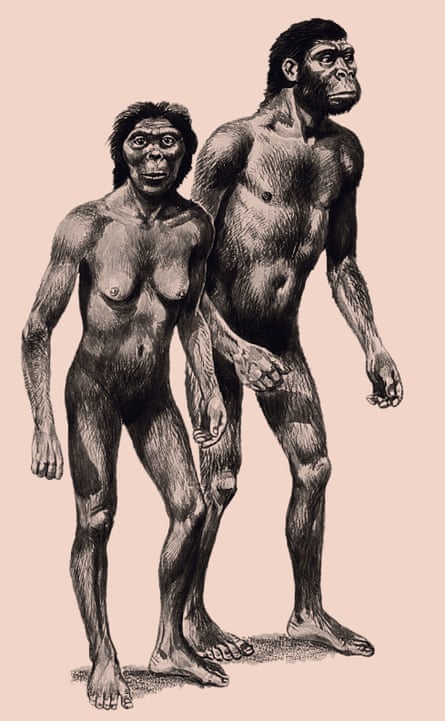
루시는 또한 아프리카가 인류의 요람이라는 인식을 확립하는 데 기여했으며, 이는 루시 종의 학명인 오스트랄로피테쿠스 아파렌시스(Australopithecus afarensis )에서도 잘 드러납니다. 과학자들은 현재 오스트랄로피테쿠스 속(분류학적 계층 구조에서 속은 종보다 상위에 위치)이 점진적으로 진화하여 남부 아프리카와 동부 아프리카 전역으로 퍼져 나갔으며, 이 종 중 하나가 인류 진화의 다음 단계의 씨앗을 뿌렸다고 생각합니다.
우리 조상들은 왜 직립보행을 시작했을까요?
전통적인 “사바나 이론”은 기후 변화로 인해 울창한 숲이 광활한 초원으로 대체되어 장거리 이동에 대한 새로운 동기를 부여했다고 주장했습니다. 그러나 두 발로 걷는 생활로의 전환은 최소 600만 년 전, 즉 아프리카 기후가 건조해져 사바나가 형성되기 훨씬 전에 시작된 것으로 보입니다. 문제를 더욱 복잡하게 만드는 것은 루시 화석에 대한 최근 분석 결과, 그녀가 사망하기 직전에 여러 차례 골절이 발생했다는 사실이 밝혀지면서, 일부에서는 그녀가 나무에서 떨어져 사망했을 가능성 을 제기하고 있습니다 .
더 최근의 가설은 두 발 보행이 숲에서 처음 출현했다는 것인데, 이는 화석 기록과 일치하며 오늘날에도 유사한 양상을 보일 수 있습니다. 수마트라 섬의 오랑우탄은 두 발로 나뭇가지를 따라 걸으며 숲의 수관을 이동하는 모습이 관찰되었습니다. 팔은 체중을 지탱하거나 매달리기 위해 사용되었으며, 다른 방법으로는 불가능했을 얇은 나뭇가지 사이를 이동할 수 있었습니다.
우리의 다리가 네 개에서 두 개로 바뀌게 된 원인은 무엇이든 수백만 년에 걸쳐 일어난 것으로 보이며, 아마도 땅과 나무 사이를 오랫동안 이동한 기간이 있었을 것입니다.
그렇다면 우리가 걷는 법을 터득하고 나서는 무슨 일이 일어났을까요?
우리 조상이 언제부터 인간으로 간주되기 시작했는지에 대한 경계는 모호하고 다소 주관적이지만, 과학자들은 그 시작점을 약 240만 년 전에 출현한 호모(Homo) 속으로 분류되는 종에서 찾을 수 있습니다. 우리는 이 집단에서 유일하게 살아남았지만, 지구는 한때 놀라울 정도로 다양한 인류의 터전이었고, 그중 일부는 우리 조상과 교류하기도 했습니다.
이들 중 가장 초기의 인류 중 하나는 240만 년에서 140만 년 전 아프리카에 살았던 호모 하빌리스 입니다. 호모 하빌리스라는 이름은 “손재주꾼”을 의미하는데, 이는 이 종이 원래 석기를 만든 최초의 사람으로 여겨졌기 때문입니다(그 이후로 330만 년 전의 날카로운 돌, 망치, 모루가 발견되었습니다). 호모 하빌리스는 키가 1~1.4미터(3피트 4인치~4피트 5인치)로 작았고, 튀어나온 얼굴과 거대한 이빨을 가지고 있었습니다. 이 때문에 한 화석에는 “호두까기 인형”이라는 별명이 붙었습니다. 그의 두개골은 오스트랄로피테쿠스보다 약 50% 더 컸지만, 현대 인류의 절반 정도였습니다.

170만~180만 년 전의 호모 에렉투스는 해부학적으로 현생 인류와 훨씬 가까웠습니다. 그는 호모 하빌리스 보다 키가 1.5~2미터(4피트 9인치~6피트 1인치) 더 크고 뇌 도 더 컸으며, 턱과 이빨도 훨씬 작았는데, 이는 식습관의 변화를 시사합니다. 하버드 대학교 인류학자 리처드 랭엄은 턱 해부학의 놀라운 변화는 호모 에렉투스가 불을 익히고 요리를 시작했으며, 이를 통해 더 효율적인 채집과 소화가 가능해져 더 큰 뇌에 에너지를 공급할 수 있었음을 시사한다고 주장합니다. 호모 에렉투스는 아프리카, 스페인, 이탈리아, 중국, 인도네시아 등지에서 화석이 발견되는 등 광범위한 지리적 분포를 보여 최초의 세계인으로 불리기도 합니다.
호모 사피엔스 (즉, 우리) 의 가장 초기 증거는 모로코의 한 동굴에서 발굴된 30만 년 남짓 전의 화석에서 비롯됩니다 . 최소 다섯 사람의 유골이 도구, 가젤 뼈, 그리고 숯덩어리와 함께 발견되었습니다. 이 화석을 발굴한 라이프치히 막스 플랑크 진화 인류학 연구소의 과학자 장 자크 위블린은 작년 가디언지와의 인터뷰에서 “우리가 발견한 표본의 얼굴은 런던 지하철에서 만날 수 있는 사람의 얼굴과 똑같습니다.”라고 말했습니다.
인류는 언제 아프리카를 떠나 전 세계로 퍼져 나갔을까요? 최근까지 화석,
유전학 , 고고학 의 다양한 증거들은 현생 인류가 약 6만 년 전 아프리카에서 유라시아로 처음 전파되었다고 주장해 왔습니다. 그러나 중국 동굴에서 발견된 10만 년 전의 인간 치아 와 이스라엘 북부에서 발견된 거의 20만 년 된 턱뼈를 포함한 최근의 발견들은 호모 사피엔스가 예전에 생각했던 것보다 훨씬 일찍 전 세계로 퍼져 나갔음 을 보여줍니다 .
그러나 이러한 초기 탈출은 현대 인구의 유전학에 거의 기여하지 않은 것으로 보입니다.아마도 이러한 그룹은 멸종했거나 이후의 이주 물결에 의해 전멸되었을 것입니다.현대 인구의 공통 조상을 삼각 측량함으로써 과학자들은 오늘날 살아있는 아프리카인과 비아프리카인의 조상이 약 6만 년 전에 수렴한다는 것을 보여줄 수 있습니다.이 조상들이 대륙을 여행하면서 유라시아의 네안데르탈인, 시베리아의 데니소바인, 아마도 인도네시아 플로레스 섬의 “호빗 “ ( 호모 플로레시엔시스 )으로 알려진 난쟁이 종을 포함하여 다른 고대 인류 종의 잡다한 종류를 만났을 것입니다.아마도 우리가 아직 알지 못하는 다른 종들.
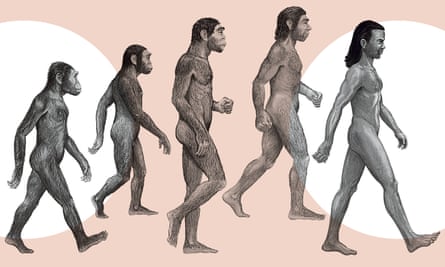
우리가 네안데르탈인을 멸종시켰을까요?
네안데르탈인은 선사 시대의 저속한 폭력배로 묘사되는 경향이 있는데, 우리 조상의 우월한 지능과 사냥 능력에 맞설 가능성은 거의 없었습니다. 하지만 이는 불공평한 고정관념일 수 있습니다. 네안데르탈인은 우리보다 뇌가 더 컸고, 보석을 제작했으며, 고대 의식에서 시신을 매장했고, 색소를 사용했는데, 아마도 부족의 표식을 위해 사용했을 것입니다.
그러나 네안데르탈인이 약 4만 년 전, 아프리카에서 온 호모 사피엔스가 유라시아에 정착하던 시기에 급격히 쇠퇴했다는 것은 사실입니다 . 아마도 그들은 자원 경쟁에 어려움을 겪었거나, 분쟁에서 목숨을 잃었거나, 아니면 단순히 우리 조상들이 북쪽과 동쪽으로 이주하게 된 기후 변화에 덜 적응했을 것입니다.
이 이야기에는 덧붙여 설명이 있습니다. 네안데르탈인은 종으로서는 멸종했지만, 어떤 의미에서는 오늘날에도 여전히 살아 있습니다. 현생 인류와 네안데르탈인의 교배로 인해 오늘날 아프리카계가 아닌 모든 인류는 약 1~5%의 네안데르탈인 DNA를 보유하고 있습니다 . 모든 인류는 네안데르탈인 유전체의 각기 다른 부분을 물려받았으며, 따라서 전체적으로 네안데르탈인 유전체의 상당 부분(최소 20%)이 현생 인류 전체에 퍼져 있습니다.
잠깐… 우리가 다른 종과 교배했다고요?
네, 유전학에 따르면 아프리카 이외 지역의 모든 조상은 네안데르탈인과 교배했으며, 아마도 한 번 이상일 것입니다. 데니소바인이라는 또 다른 고대 집단과의 교배도 있었습니다. 이 다른 고대 사촌들의 화석이 너무 단편화되어 있어서 그들의 생김새에 대해서는 알려진 바가 거의 없습니다. 하지만 시베리아 동굴에서 발견된 손가락 뼈에서 과학자들은 약 4만 1천 년 전에 살았던 데니소바인 소녀의 고품질 DNA를 추출할 수 있었습니다.
흥미로운 점은 데니소바인의 DNA가 현대의 호주 원주민과 파푸아뉴기니인에게만 나타난다는 것입니다. 이는 이들의 조상이 지구를 여행하던 중, 아마도 동남아시아 어딘가에서 데니소바인을 만났을 것이라는 것을 시사합니다.
우리는 이러한 교배 사건의 상황과 그것이 서로 다른 부족의 평화로운 합병이었는지 아니면 폭력적인 충돌이었는지에 대해서만 추측할 수 있습니다.
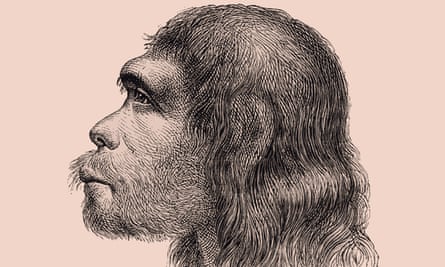
복제를 통해 멸종된 사촌들을 되살릴 수 있을까요?
이론적으로는 네안데르탈인이나 데니소바인의 돌연변이를 현대 인간 유전체에 복사하여 붙여넣은 다음, 이를 난자에 이식하여 대리모를 통해 아기를 키울 수 있습니다. 하버드 대학 유전학자 조지 처치는 그의 저서 『재생: 합성 생물학이 자연과 우리 자신을 어떻게 재창조할 것인가』(Regenesis: How Synthetic Biology Will Reinvent Nature and Ourselves) 에서 유전 공학을 이용하여 멸종된 생물을 부활시킬 가능성에 대해 분석합니다. 처치는 “사회가 복제에 편안함을 느끼고 진정한 인간 다양성의 가치를 인식한다면, 네안데르탈인 전체를 대리모 침팬지, 혹은 매우 모험심이 강한 여성 인간에 의해 복제할 수 있을 것”이라고 썼습니다.
이 실험보다 윤리적으로 덜 위험한 버전에서는 현재 여러 연구실의 과학자들이 네안데르탈인 세포와 심지어 기관소체(작은 뇌와 간)를 배양하여 네안데르탈인의 생물학이 우리와 어떻게 다른지 더 잘 이해하고자 노력하고 있습니다.
우리는 언제 말하는 법을 배웠을까요?
언어는 화석 기록에 직접적인 흔적을 남기지 않고, 오늘날의 신경과학자들조차 인간의 뇌가 어떻게 언어를 생성하는지 완전히 이해하지 못하기 때문에 이는 까다로운 문제입니다. 어떤 사람들은 집단 사냥과 기타 정교한 행동에 대한 초기 증거를 바탕으로 원시적인 형태의 언어가 호모 사피엔스 보다 앞서 존재했다고 주장 합니다. 예를 들어, 50만 년 된 호모 하이델베르겐시스 화석(또 다른 멸종된 친척)인 박스그로브인은 현재 멸종된 코뿔소, 곰, 들쥐의 유해와 함께 발견되었는데, 도살된 흔적이 있었습니다.
언어에 필수적인 것으로 알려진 소위 언어 유전자 FOXP2 역시 단서를 제공합니다. 호모 사피엔스 의 이 유전자는 침팬지나 다른 동물에서는 발견되지 않는 돌연변이를 가지고 있습니다. 이제 우리는 네안데르탈인도 이와 동일한 돌연변이를 공유했다는 것을 알고 있습니다. 그러나 현대인은 FOXP2 유전자의 활성화 및 비활성화 시점을 결정하는 FOXP2 측면 DNA에 두 배나 많은 돌연변이를 가지고 있습니다. 이는 현대인이 우리 친척들과는 질적으로 다른 언어 능력을 진화시켰을 가능성을 시사합니다.
그 다음은 무엇인가?
인류의 진화는 아직 끝나지 않았지만, 앞으로 어떻게 될지 예측하는 것은 불가능합니다. 우리가 끊임없이 상승하는 지적 궤도에 있다고 가정하고 싶지만, 이를 보장할 수는 없습니다. 실제로 인간의 뇌는 지난 2만 년 동안 약 5~10% 정도 작아졌습니다. 이는 가축에서 나타나는 현상과 유사할 수 있는데, 가축은 야생 동물보다 거의 항상 작은 뇌를 가지고 있기 때문입니다. 스트링거는 “어쩌면 우리가 스스로를 가축화하면서 조상들에게 필요했던 뇌의 일부가 더 이상 중요하지 않게 되었을지도 모릅니다.”라고 말합니다.
개인의 두뇌 능력을 집단적 지능으로 대체하고 있을 가능성도 있습니다. 스트링거는 “우리의 두뇌는 에너지적으로 매우 비쌉니다. 우리 에너지의 약 20%를 사용합니다.”라고 말합니다. “따라서 진화가 더 작은 두뇌를 만들어낼 수 있다면, 그렇게 될 것입니다.”
추가 읽기
토마스 헉슬리의 자연 속 인간의 위치에 대한 증거
도널드 조핸슨과 메이틀랜드 에디의 루시: 인류의 시작
루이스 험프리와 크리스 스트링거의 인간 이야기
조지 처치의 『재생 : 합성생물학이 자연과 우리 자신을 어떻게 재창조할 것인가』
아담 러더퍼드의 『지금까지 살았던 모든 사람들의 간략한 역사 : 우리 유전자 속 이야기』독립적인 언론은 지구를 지키는 중요한 방어선입니다. 오늘, 저희의 연례 기후 캠페인을 지지해 주세요.
Independent journalism is a critical line of defence for our planet. Support our annual climate appeal today.
0 of
40,00040,000건의
acts of support지원 행위 중 0건
그것은 정규직이에요…
극단적인 정치와 극심한 기후는 서로 얽혀 있으며, 우리가 살고 있는 다중 위기를 이해하고 극복하려면 둘 다 해결해야 합니다.
전 세계적으로 강력한 정부, 금융 기관, 대형 석유 회사가 기후 약속을 외면하고 있으며, 일부는 우리에게 필요한 진전에서 벗어나고자 하는 비밀 로비 단체와 극우 정치인에게 자금을 지원하고 있습니다.
반발은 충격적이었습니다.
그러나 기후 위기가 새로운 선동가들의 시대를 만들어내는 이유를 분석하는 언론 기관은 거의 없습니다. 권위주의적 지도자들이 어떻게 대중의 관심을 현재 전 세계적인 불황의 근본 원인에서 다른 곳으로 돌리려 하는지 면밀히 살펴보는 언론 기관은 더욱 드뭅니다.
가디언은 다릅니다. 저희 기자들은 환경 보호의 진전과 발전을 저해하는 세력을 폭로하는 데 전념합니다. 기후 관련 허위 정보를 폭로하는 것은 풀타임 업무입니다.
만약 경제적으로 여유가 되신다면, 오늘 당장 가입하시기 바랍니다. 가입하는 데 1분도 걸리지 않습니다.
Tracing the tangled tracks of humankind’s evolutionary journey
This article is more than 7 years old
The path from ape to modern human is not a linear one. Hannah Devlin looks at what we know – and what might be next for our species
Hannah Devlin Science correspondentMon 12 Feb 2018 16.51 AEDTShare
Let’s go back to the beginning. When did we and our ape cousins part ways?
Scientists are still working on an exact date – or even a date to within a million years. Like many of the big questions in human evolution, the answer itself has evolved over the past few decades as new discoveries, techniques and technology have provided fresh insights.
Genetics has proved one of the most powerful tools for time-stamping the split with our closest living relative, the chimpanzee. When our complete genomes were compared in 2005, the two species were found to share 98% of their DNA. The differences hold important clues to how long our lineages have been diverging. By estimating the rate at which new genetic mutations are acquired over generations, scientists can use the genetic differences as a “molecular clock” to give a rough idea of when the split occurred. Most calculations suggest it was between four to eight million years ago.
This time window is more recent than was originally thought. In the 1960s, fossil evidence led palaeontologists to conclude that a 14m-year-old ape, Ramapithecus, was the earliest ancestor on the human line, based on the shape of its jaw. Subsequent DNA analysis has revealed the split occurred long after that – Ramapithecus is now considered an orangutan ancestor.
So are scientists still looking for the “missing link” between us and other ape species?
We still don’t know the identity of our most recent common ancestors with chimpanzees. But scientists tend to dislike the phrase “missing link”, as it implies that evolution proceeds in an orderly, linear fashion with well-defined junctures.
“It gives the sense that there is a single transitional form that magically bridges the gap between a living ape and a living human and suggests we’ve got to fit everything into our line of evolution,” says Chris Stringer, head of human origins at the Natural History Museum.
The reality is messier: different branches evolve at different rates; new traits can emerge several times independently; splits can be dragged out over millennia and across continents, with populations diverging and then interbreeding again. Rather than the tree of life it’s more like a dense, thorny bush.
But can we assume that our last shared ancestor with other living apes was something like a chimp?
Not necessarily – chimps are not simply unevolved versions of us. Our hypothetical common ancestor would have had a mixture of chimp-like traits, human-like traits and primitive traits that both species eventually left behind. The common ancestor might have walked on all fours, or might have been more upright.
Scientists are still trying to piece together this evolutionary jigsaw puzzle based on a shifting cast of creatures that show up in the fossil record. To complicate things, most of the fossils found probably represent evolutionary side-branches rather than direct ancestors.Quick Guide
Evolutionary timeline
Show
What are some of the important fossils I should know about?
One of the earliest specimens that people believe lies on our lineage – or not far from it – is Sahelanthropus tchadensis, a six to seven-million-year-old fossil found in Chad. It has an ape-like sloping face, prominent brow and very small brain, but small human-like canine teeth. The spinal cord is positioned underneath the skull, rather than towards the back, which some say suggests the creature walked on two legs, but it’s hard to know for sure, since there’s just a skull and a few bones to go on.
Another fossil from around the same period found in Kenya, called Orrorin tugenensis (nicknamed Millennium Man), also features small teeth and a leg bone that indicates primitive bipedalism.
Slightly later, at 4.4m years, there is Ardipithecus ramidus (Ardi), a stunningly complete female skeleton found in Ethiopia. Ardi, who had a stocky frame and stood almost four feet (one metre) tall, had gangly ape-like arms and grasping big toe, suggesting she would have been an agile climber. Scientists are divided on the extent to which Ardi walked upright – some say she would have walked on two legs routinely, others think she would have just about managed it if she needed to use her arms to carry something. The pelvis bones are crushed and the skeleton does not include a knee, which could have helped resolve the question more definitively. The strongest evidence for Ardi being a direct ancestor, or very close to our lineage, comes from her teeth, which were small and stubby – more like modern human teeth – and lacked the large fang-like canines of chimpanzees, gorillas and earlier extinct apes.
Then comes “Lucy”, a 3.18m-year-old skeleton, named after the Beatles song Lucy in the Sky with Diamonds, the soundtrack to the 1974 excavation. Lucy is viewed as one of the most important discoveries in palaeontology as she is a unique amalgam of primitive features – a chimpanzee-sized brain, a powerful jaw and long, dangling arms – and incredibly human ones. In particular, her legs, knee and pelvis are strikingly similar to our own anatomy, suggesting that by this point our ancestors had gained the distinctive human abilities of being able to walk and run.
Lucy also helped cement a growing acceptance of Africa as the cradle of humanity, reflected in her species’ scientific name: Australopithecus afarensis. Scientists now think that the australopithecine genus (in the taxonomical hierarchy, genus is one up from species) gradually evolved and spread across southern and eastern Africa – and that one of these species seeded the next phase of our evolution.
Why did our ancestors start walking upright?
The traditional “savannah theory” held that shifts in the climate led to dense forests being replaced by sweeping grasslands, creating a new incentive for being able to travel long distances by foot. Yet the transition towards bipedalism appears to have started at least six million years ago – long before the African climate dried out enough to create savannahs. To complicate matters further, a recent analysis of the Lucy fossil suggests that multiple fractures had been sustained shortly before her death, leading some to speculate that she may have died falling out of a tree.
A more recent idea is that bipedalism first emerged in the forests, which would be consistent with the fossil record and may also have a modern-day parallel. Orangutans in Sumatra have been observed moving through the forest canopy by walking along branches on two legs while using their arms to help support their weight or hang, allowing them to move through thinner branches than would otherwise be possible.
Whatever prompted our transition from four legs to two, it seems to have happened over millions of years, probably with a long period of travelling between the ground and the trees.
So once we got the hang of walking, what happened next?
The boundary for when our ancestors started counting as human is blurry and somewhat subjective, but scientists place the starting point at species that emerged about 2.4m years ago, which are designated to the Homo genus. We are the sole survivors of this group, but the Earth was once home to a surprising diversity of humans, some of whom crossed paths with our own ancestors.
One of the earliest of these is Homo habilis, who lived in Africa between 2.4m and 1.4m years ago. The name means “handyman” because this species was originally thought to represent the first maker of stone tools (since then, sharpened stones, hammers and anvils dating to 3.3m years ago have been discovered). Homohabilis was short (between one and 1.4 metres or 3ft 4in – 4ft 5in) had a protruding face and massive teeth – earning one fossil the nickname Nutcracker Man. His braincase was about 50% bigger than that of the Australopithicenes, but still only half as big as a modern human’s.
Homo erectus, 1.7-1.8m years ago, was much closer to modern humans anatomically. He was taller (1.5 to two metres or 4ft 9in – 6ft 1in) and bigger-brained than Homo habilis and had a far smaller jaw and teeth, implying a change in diet. Harvard anthropologist Richard Wrangham argues that the striking change in jaw anatomy suggests Homo erectus mastered fire and began cooking, allowing more efficient foraging and digestion, freeing up energy to fuel a larger brain. Homo erectus has sometimes been called the first cosmopolitan, due to the impressive geographical range it spanned, with fossils found in Africa, Spain, Italy, China and Indonesia.
The earliest evidence of Homo sapiens (that’s us) comes from fossils dated to just over 300,000 years ago excavated from a cave in Morocco. The bones of at least five people were found alongside tools, gazelle bones and lumps of charcoal. Jean-Jacques Hublin, a scientist at the Max Planck Institute for Evolutionary Anthropology in Leipzig who excavated the fossils, told the Guardian last year: “The face of the specimen we found is the face of someone you could meet on the tube in London.”
When did humans leave Africa and spread across the globe?
Until recently, converging lines of evidence from fossils, genetics and archaeology suggested that modern humans first spread from Africa into Eurasia about 60,000 years ago. However, a series of recent discoveries – including a trove of 100,000-year-old human teeth found in a cave in China, and a nearly 200,000-year-old jawbone in northern Israel – show that Homo sapiens was venturing across the world far earlier than once thought.
However, these early exits appear to have contributed very little to the genetics of modern day populations – perhaps these groups died out or were killed off by subsequent migratory waves. By triangulating the common ancestors of modern day populations, scientists can show that the ancestors of African and non-African people alive today converge at around 60,000 years ago. As these ancestors travelled across continents they would have encountered a motley assortment of other archaic human species, including the Neanderthals in Eurasia, the Denisovans in Siberia, possibly a dwarf species known as “the hobbit” (Homo floresiensis) on the Indonesian island of Flores and probably other species that we do not yet know about.
Did we kill off the Neanderthals?
Neanderthals tend to be cast as the low-browed thugs of the prehistoric world, who stood little chance against the superior intellect and hunting prowess of our own ancestors. This may be a case of unfair stereotyping, though. Neanderthals had bigger brains than us, they made jewellery, buried their dead in ancient ceremonies and used pigments – possibly for tribal markings.
It is true, however, that the Neanderthals went into a steep decline around 40,000 years ago, at a time when Homo sapiens from Africa were settling in Eurasia. Perhaps they were struggling to compete for resources, were killed in conflicts or were simply less well adapted to changes in climate that led our own ancestors to move north and east.
There’s a postscript to this story. While the Neanderthals died out as a species, in one sense they are still around today. Interbreeding between modern humans and Neanderthals means that all non-Africans alive today carry about 1-5% Neanderthal DNA. Everyone has acquired slightly different parts of the Neanderthal genome and so collectively there is a substantial fraction (at least 20%) of the Neanderthal genome spread through the living human population.
Wait … we interbred with another species?
Yes, genetics shows that the ancestors of everyone outside of Africa interbred with Neanderthals, probably more than once. There was also interbreeding with another archaic group called the Denisovans. We don’t know much about what these other ancient cousins looked like as their fossils are so fragmented. But from a finger bone found in a cave in Siberia, scientists were able to extract high quality DNA belonging to a Denisovan girl who lived about 41,000 years ago.
Intriguingly, Denisovan DNA shows up only in modern day Indigenous Australians and Papua New Guineans, suggesting that their ancestors must have met the Denisovans on their way across the globe, probably somewhere in south-east Asia.
We can only speculate on the circumstances of these interbreeding events and whether they were peaceful mergers of different tribes or violent encounters.
Could we use cloning to bring our extinct cousins back to life?
Theoretically, it would be possible to cut and paste Neanderthal or Denisovan mutations into a modern human genome, and then transfer that into an egg and grow a baby using a surrogate mother. In his book Regenesis: How Synthetic Biology Will Reinvent Nature and Ourselves, Harvard geneticist George Church speculates about the possibility of using genetic engineering to resurrect extinct creatures. “If society becomes comfortable with cloning and sees value in true human diversity, then the whole Neanderthal creature itself could be cloned by a surrogate mother chimp – or by an extremely adventurous female human,” Church wrote.
In a less ethically fraught version of this experiment, scientists at several labs are currently growing Neanderthalised cells and even organoids – miniature brains and livers – to better understand how Neanderthal biology differed from our own.
When did we learn to speak?
This is tricky, as language leaves no direct trace on the fossil record and even today’s neuroscientists haven’t fully figured out how the human brain produces language. Some argue that primitive versions of language pre-date Homo sapiens, based on early evidence of collective hunting and other sophisticated behaviours. For instance, Boxgrove Man, a 500,000 year old Homo heidelbergensis fossil (another extinct relative), was found alongside the remains of now extinct species of rhinoceros, bears and voles, which had signs of having been butchered.
The so-called language gene FOXP2, known to be crucial for speech, also holds clues. The Homo sapiens version of this gene has mutations that are not seen in chimps or other animals. We now know that Neanderthals shared these same mutations. However, modern humans have double the number of mutations in FOXP2’s flanking DNA that determines when the gene is switched on and off, hinting that we could have evolved a qualitatively different capacity for language than our relatives.
What next?
Human evolution is not over, but it’s impossible to predict how we’re going to turn out. It’s tempting to assume that we are on an ever-upward intellectual trajectory, but there’s no guarantee of this. In fact, the human brain has become about 5-10% smaller during the past 20,000 years. Perhaps this is comparable to the pattern seen in domestic animals, which almost always have smaller brains than their wild counterparts. “Maybe we’ve domesticated ourselves and those bits of the brain that our ancestors needed aren’t so important any more,” says Stringer.
It’s also possible that we are swapping individual brainpower for collective forms of intelligence. “Our brains are energetically very expensive – they use about 20% of our energy,” says Stringer. “So if evolution can get away with a smaller brain it will.”
Further reading
Evidence as to Man’s Place in Nature by Thomas Huxley
Lucy: The Beginnings of Humankind by Donald Johanson and Maitland Edey
Our Human Story by Louise Humphry and Chris Stringer
Regenesis: How Synthetic Biology Will Reinvent Nature and Ourselves by George Church
A Brief History of Everyone Who Ever Lived: the Stories in Our Genes by Adam Rutherford
Independent journalism is a critical line of defence for our planet. Support our annual climate appeal today.
11,298 of 40,000 acts of support
They’re fighting dirty, we’re fighting back …
Across the planet, progress towards urgent action on climate is being threatened by populist politicians and governments, fossil fuel influence and corporations emboldened by the political winds to roll back their green pledges.
Here in Australia, there is a worrying gap between ambition and action, as media and political interests muddy the waters with increasingly aggressive disinformation. Meanwhile, in the US, a growing lobby of economic and political denial has been empowered by an administration that has declared war on climate progress and wider environmental protections.
One powerful way to turn back this tide is by funding strong, independent journalism that stands up for the facts.
The Guardian doesn’t bow to political pressure and we don’t take advertising from fossil fuel companies. We are not bankrolled by a billionaire. Our work is funded by readers like you. For our annual environment support campaign, we are asking 40,000 readers to back our journalism.